What lemur species live in Madagascar?
Madagascar is home to over 100 known species and subspecies of lemurs. These unique primates are found nowhere else on earth. They include the large indri, famous for its powerful calls, and tiny mouse lemurs, mostly active at nite.
Some of the best-known lemur species are indri, ring-tailed lemur, sifakas, bamboo lemurs, brown lemurs, mouse lemurs and aye-aye. They all live in specific habitats throughout Madagascar, so the species a visitor sees depends on the area and forest visited.
Wildlife travelers will find knowing about these differences helpful in deciding which national parks to visit and planning a Madagascar lemur safari.
1. Indri – The largest living lemur
The indri (Indri indri) is the largest living lemur. It is recognised by its black-and-white fur, upright posture and distinctive calls, which can carry through Madagascar’s eastern rainforests.
Where to see it: Andasibe-Mantadia National Park, particularly the Analamazaotra sector, is one of the most renowned sites to see wild indri.
What makes it special: Indris are loud animals, their calls are loud to communicate. They spend a lot of time traveling around the forest canopy.
Best for: Tourists keen on rainforest wildlife and one of Madagascar’s most distinctive primates.
2. Ring-tailed lemur – The lemur with the striped tail
The ring-tailed lemur (Lemur catta) is easily recognizable by its long, black and white striped tail, gray body and expressive face. Unlike many lemurs that spend most of their time in trees, this species regularly moves on the ground.
Where to see it: Ring-tailed lemurs can be found in many places, but a popular place to see them is in Anja Community Reserve near Ambalavao. Also seen in the Isalo National Park.
Why it’s special: Ring-tailed lemurs are both nocturnal and diurnal and are often seen sun-bathing in open areas.
Best for: Wildlife photography, crossing the south of Madagascar.
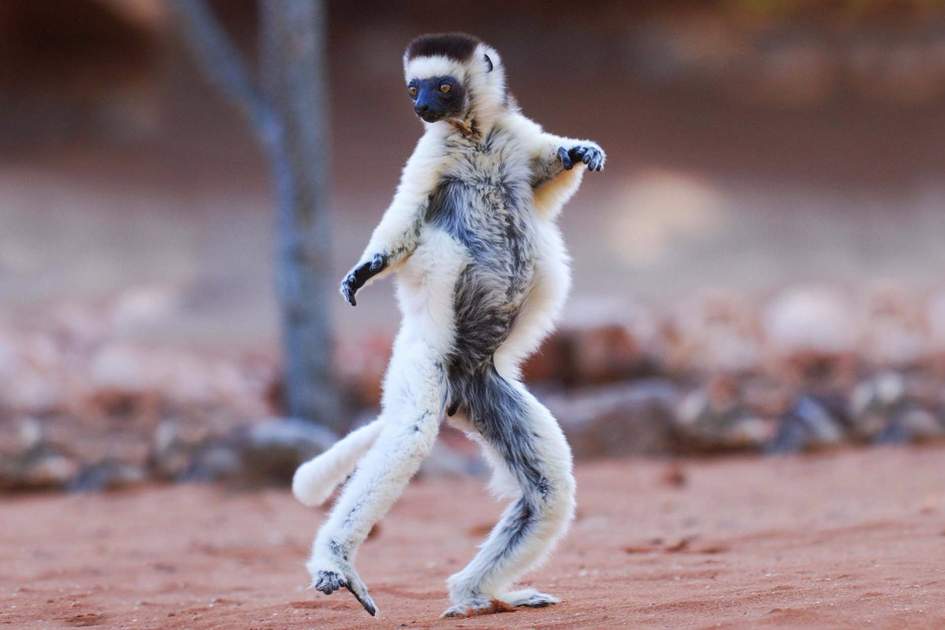
3. Sifakas – Madagascar’s famous jumping lemurs
Sifakas are known for their strong movements between trees and their unique sideways bounds when traveling over open ground.
Sifaka live in several species on Madagascar, and their range is determined according to the forest region.
-
Diademed Sifaka (Propithecus diadema) Found in eastern rainforest habitats including Andasibe region.
-
Verreaux’s sifaka (Propithecus verreauxi) – This species lives in western and southern Madagascar, including around Kirindy and Isalo.
-
Milne-Edwards’ sifaka (Propithecus edwardsi): This rainforest species inhabits the southeastern part of Madagascar, including the Ranomafana region.
Best for: Visitors interested in primate behavior, forest habitats and the varied landscapes of Madagascar.
4. Bamboo lemurs – Specialists of bamboo forests
Bamboo lemurs are inherently associated with forest habitats rich in bamboo. They eat bamboo and are therefore of special interest to wildlife researchers and visitors.
Two species of note are:
-
Golden bamboo lemur (Hapalemur aureus): It is found in the Ranomafana rainforest area.
-
Greater bamboo lemur (Prolemur simus) – A highly endangered species, found only in restricted areas of Madagascar.
Where to find it: You can learn all about the bamboo lemur and its rain forest habitat with a trip to Ranomafana National Park.
Best for: Conservationists and rare primate enthusiasts.
5. Mouse lemurs – Madagascar’s tiny nocturnal primates
Mouse lemurs are the smallest primates in the world. Their eyes are big, their bodies are small, and they are mostly nocturnal.
There are several species of mouse lemurs in Madagascar, different species in different forest areas.
Where to find them: The Kirindy Forest in western Madagascar is of particular importance for mouse lemur diversity. It is also the home of one of the world’s smallest primates, Madame Berthe’s mouse lemur (Microcebus berthae).
Best for: Evening walks and nite wildlife.
6. Aye-aye – One of Madagascar’s most unusual lemurs
The aye-aye (Daubentonia madagascariensis) is a nocturnal lemur with large ears, prominent eyes and a specialised long middle finger. It uses this finger to extract insect larvae from inside trees.
Aye-ayes are difficult to observe in the wild because they are nocturnal and elusive.
Where to look: Aye-ayes occur in forest habitats in different parts of Madagascar. Specific reserves and guided wildlife programmes may offer opportunities, but sightings should never be assumed.
Best for: Experienced wildlife enthusiasts interested in unusual nocturnal primates.
Which lemur species can you see at each destination?
| Destination | Notable lemurs to look for |
|---|---|
| Andasibe-Mantadia | Indri, diademed sifaka |
| Ranomafana | Golden bamboo lemur, greater bamboo lemur, Milne-Edwards’ sifaka |
| Kirindy Forest | Verreaux’s sifaka, Madame Berthe’s mouse lemur, red-fronted brown lemur |
| Anja Community Reserve | Ring-tailed lemur |
| Isalo National Park | Ring-tailed lemur, Verreaux’s sifaka |
| Lokobe, Nosy Be | Black lemur |
Species presence and visibility vary by location, season and forest conditions. A knowledgeable local guide can help identify the species that are realistically found in each area.
How to choose the right Madagascar lemur safari
If you want to see a particular species, plan your trip around where it lives.
-
For indri, add Andasibe-Mantadia.
-
Ring-tailed lemurs: Anja Community Reserve and Isalo National Park.
-
Ranomafana should be added for bamboo lemurs.
-
For nocturnal lemurs: Take a guided nite walk in a suitable reserve such as Kirindy.
-
For black lemurs: Try Lokobe national park on Nosy Be.
Combining several regions can provide a broader wildlife experience, but distances and road conditions matter. A realistic route is more rewarding than trying to visit every park in a short holiday.
Frequently asked questions about lemurs in Madagascar
How many lemur species are found in Madagascar?
More than 100 lemur species and subspecies are recognised in Madagascar. Scientific classifications can change as research improves our understanding of lemur populations.
What is the largest lemur in Madagascar?
The indri (Indri indri) is the largest living lemur. It is known for its distinctive black and white colors and its loud calls.
Where can I see ring-tailed lemurs in Madagascar?
Ring-tailed lemurs are often easily seen in the wild in well-known destinations such as the Anja Community Reserve, near Ambalavao, and Isalo National Park.
Are all lemurs in Madagascar endangered?
Lemur conservation status differs by species, but the group faces serious conservation pressure. Habitat loss, forest fragmentation and hunting are among the major threats. The IUCN’s SOS Lemurs initiative reports that most recognised lemur taxa are threatened with extinction.
Can I see lemurs at night in Madagascar?
Yes. Lemur species that are nocturnal include mouse lemurs and aye-ayes. Guided night walks in suitable reserves can provide opportunities to look for them.
What is the best national park for seeing different lemur species?
There is no single best park for every species. Andasibe-Mantadia, Ranomafana and other protected areas each support different lemur communities. The best choice depends on the species you hope to see and your travel route.
Plan your Madagascar lemur safari with Pearl Nature Holidays
Madagascar’s lemurs are among the island’s most remarkable wildlife experiences. From the indri calls of the eastern rainforests, to the ring-tailed lemurs of the south, and the nocturnal mouse lemurs of the western forests, each region offers a different opportunity to discover these unique primates.
Pearl Nature Holidays can help you to plan a Madagascar wildlife holiday for the destinations that you prefer, your available travel time and your wildlife interests.